Severn Railway Bridge
To Lydney: Severn Bridge Station
To Sharpness: Sharpness
History
Work began in 1875 with the foundation stone of the first pier laid on 4th June by the chairman of the Severn Bridge Railway, Mr Lucy.The work was completed in 1879.
The bridge was 4,162 foot (1,268 m) long, and 70 foot (21.3 m) above high water. The contractors for the construction of the metal portions of the bridge were Messrs. Hamilton's Windsor Iron Company of Liverpool, who also built Clevedon Pier. The contractors for the railway and masonry portion of the bridge were Messrs. Vickers and Cook, London.
On 25 October 1960, two barges, the Arkendale and the Wastdale, collided in heavy fog with one of the columns of the bridge, causing two spans to collapse. Part of the structure hit the barges, which were carrying petrol, setting fire to them. In addition, a 12 inch gas main which crossed the bridge from Sharpness to Lydney was also severed. Five people died in the incident. The bridge was deemed to be damaged beyond economic repair and was eventually dismantled in 1970, although several of the stone piers remain.
1960s
-
 A 1966 view of the bridge taken from the north side of the river. © John Thorn

2004
-
 The view of the remains of the Severn Railway Bridge as approached from the Sharpness end of the 16-mile Gloucester & Sharpness Canal.
 -
 The eastern abutment of the bridge towers over the canal.
 -
 The bridge was designed with a portion that could swing to allow larger boats passage along the canal. This is the pivot. The swinging section of bridge was built by Hamilton's Windsor Iron Works of Liverpool, who also built Clevedon Pier.
 -
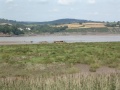 Looking across the River Severn and several large chunks of bridge are still lying in the mud.
 -
 The course of the bridge as viewed from the Sharpness end of the canal. Several bumps in the river show the exact route the bridge took.


